
T P Sreenivasan was India's high commissioner in Fiji in 1987, when Sitiveni Rabuka toppled the Indian-dominated government there. Ambassador Sreenivasan stayed on for two years after the coup, fighting for the rights of the people of Indian origin before he was expelled by Rabuka. 'Meeting Sitiveni Rabuka, who had overthrown a democratically elected government, discriminated against the Fiji Indians, brought untold humiliation and suffering to them, tried to disenfranchise them, ordered me out of Fiji and closed down the Indian high commission was a difficult decision to take even after 25 years,' notes Ambassador Sreenivasan who eventually caught up with Rabuka over a game of golf.

'This generation wants to try different things, are ready to take risks and experiment with their careers.'

Here's your weekly digest of the craziest and funniest stories from around the world.

BCCI's decision to not send Indian teams for the Asian Games drew sharp criticism from the Olympic Council of Asia (OCA) on Saturday, which accused the influential cricket board of treating the sport just as a business venture.

Incoming US President Donald Trump has assembled a core team that is -- not surprisingly -- overwhelmingly white and male.

'Well begun is half done, today there are more hits than misses by the Modi government in its support towards science in India,' says Pallava Bagla.

Nayan Khanolkar, Wildlife Photographer of the Year 2016, tells Rediff.com's Divya Nair his story.

Women behind the wheel, movie theatres and now snowmen! Everyday things in the outside world are prohibited in Saudi Arabia's incredibly conservative society. Rediff.com compiles a list

'More than 1,000 start-ups are created from colleges, and more start-ups are coming up every year.'

'From envy, heartburn and broken hearts to broken marriages, much damage has been done by unintended revelations in the social media. Suspicious partners bring out hidden relationships, which may never have come to light and hell breaks lose in many lives,' warns T P Sreenivasan.
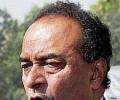
'If the court realises, within a couple of years, that women are making all kinds of allegations for other ulterior motives, then it will become difficult for women,' well-known Supreme Court lawyer Mukul Rohatgi tells Rediff.com's Sheela Bhatt.

Rajeev Srinivasan on how Indians are satisfied with illusions, not reality.

'The people of the state can be won over by love, and not by swords.'

Focus on the best you can do with what you've been given.

The Politburo Standing Committee -- the most powerful body in China -- is unveiled, but in a break from Communist party convention, no successor to Xi Jinping is named.

'There are so many dimensions to history that we need to attend to: We need more space for local and regional histories; we need to delve into the histories of particular communities; we need to emphasise gender history and environmental history.' 'We need to think about India's history beyond India's current borders.'

The White House said it has 'a large body' of evidence indicating that the Assad regime was responsible for the April 7 chemical attack in Duma.

With the weaker-than-expected agreement at the recent Climate Change Conference at Lima, there is an urgent need to highlight endeavours in civil society and business for a sustainable global economy with grassroots empowerment, say Rajni Bakshi.

'Healthcare is so expensive that while it saves lives, it destroys more lives socially and financially.' 'While the poor gets wiped out, a middle-class man goes to a corporate hospital and after the treatment, he ends up below the poverty line.' 'Generally, hospitals would like to have patients who need procedures and operations.' 'They are not so fond of palliative care.' 'How much can be made from one hour of counselling? And how much can be made from one hour of an operation?'

'The writers fear that the fringe is threatening to become the mainstream and the liberal space -- a must for any creative expression -- is fast shrinking,' says Mohammad Asim Siddiqui.

Days before Narendra Modi arrives in the US to speak at the UN, meet Barack Obama, gupshup with the likes of Nadella, Pichai, Zuckerberg, and address desis in Silicon Valley, his ministers will help set the commercial and strategic tone for the prime minister's visit.

Narendra Modi's victory does not represent a victory of 'the Indian nation', but only an elite-driven polarising phenomenon. The sooner we -- and the BJP -- recognise this, the better, says Praful Bidwai.
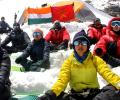
Today, it is modish to be part of a yoga class, to post stories on Instagram while striking an impressively complex asana in a bralette and crop-top paired with neon yoga pants, to bond over green tea and yoga bars after a strenuous session at the studio and have subscriptions to yoga studios, not ashrams, says Manavi Kapur.

'There is a Jack Warner or two in every Caribbean parliament today.'

'This has to be seen in the context not only of the legacy we inherited, but also of global economic weakness.'
'If after inheriting the very bad situation we have reached this level despite consecutive years of drought and no growth in the world economy, it is no accident.' 'It is a result of the sound macro economic policies followed by this government.' 'We have eschewed populism and stuck to a path of fiscal prudence.'
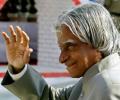

Arvind Panagariya speaks about climate change, globalisation and India's economy.
AMU has once again been pulled into a crossfire of crass political opportunism. In these post-truth times, that the university also had political stirrings not subscribing to the Muslim League is chosen to be forgotten, says Mohammad Sajjad.
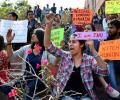
When it came to dealing with the media and academia, it has been a roller coaster ride for the National Democratic Alliance, observes Nitin Sethi.

'Why not ask for a change of leadership in Qatar, Bahrain or Saudi Arabia? Is there a constitution in Saudi Arabia? Are there elections in Saudi Arabia? Why no talk of democracy in these countries?' 'America said change the leader now, but is now ignoring the feelings of the Syrian moderate majority. Is that democracy,' asks H E Dr Riad Abbas, Syrian ambassador to India, in an interview to Cleo Paskal.

'Growth is predicated on the misery of large sections of people.' 'Maybe Hindutva will be used to suppress any such unrest.'
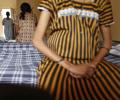
The central government has drafted a law to restrict wombs for hire, and there is much to be said on all sides.

'Elected representatives have won elections in the past on the basis of money power received from the central government.' 'This fact has been highlighted by former army chief V K Singh who boasted of crores of rupees being distributed to Kashmiri politicians in order to buy their loyalty and win votes.' 'All the Kashmiri politicians have been co-opted by the Indian State,' says separatist Hurriyat leader Syed Ali Shah Geelani.

'Why would the Communists do this? I have three possible answers: One, they are specifically opposed to the Global Education Meet that the ambassador organised. Two, they are beginning to realise their days are numbered in Kerala. Three, the standard modus operandi of leftists is anarchism because they are not constrained by any codes of ethics. Roughly, the bad, the good, and the ugly,' says Rajeev Srinivasan.

This is the joint statement issued by the ministry of external affairs on the visit of US President Barack Obama to India.

'Dadri was an extension of the cultural fascism that was happening in the country.' 'All the people in the country suffered under the Emergency, but now we see one community trying to crush the other community. Do they know what is brewing in the minds of the other side? What is happening today can lead to a very dangerous situation in the country.' 'We have lost religious tolerance in today's India.' Writer Sarah Joseph on why she returned her Sahitya Akademi Award.

'It is in the interest of both sides that the visit of the US President is seen as being successful. Both sides have invested considerable political capital in it. This rapid exchange of visits and the decisions taken have to be justified, beyond the symbolism, which is no doubt important in itself. This opportunity to impart a fresh momentum to ties should not be missed,' says former foreign secretary Kanwal Sibal.

'We saw how vigorous democracy was when it dislodged authoritarianism under Indira Gandhi. We saw its vigour again when it voted Mr Modi out of humble origins as prime minister. It was Nehru who laid that foundation for India and what is worrying today is Modi's rather imperial style of functioning,' says writer Nayantara Sahgal.
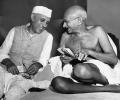
'How come with Nehru at the helm, India missed so many buses? He had such unchallenged power that he could have taken the country in any direction he wanted. The sad conclusion is inescapable that Nehru let things drift in true Hamletian ambivalence,' says B S Raghavan.
